Enterprise Architecture as a Value Blueprint for a Smart Campus DPU x TCCtech Join Forces to Build the Foundation of Future Education in the AI Era
Enterprise Architecture as a Value Blueprint for a Smart Campus DPU x TCCtech Join Forces to Build the Foundation of Future Education in the AI Era
Amid the rapid changes of the digital world, advances in artificial intelligence (AI), and evolving learner expectations, universities worldwide are facing a critical challenge which is redefining their roles and educational models to preserve the value of education while preparing students to meet future challenges.
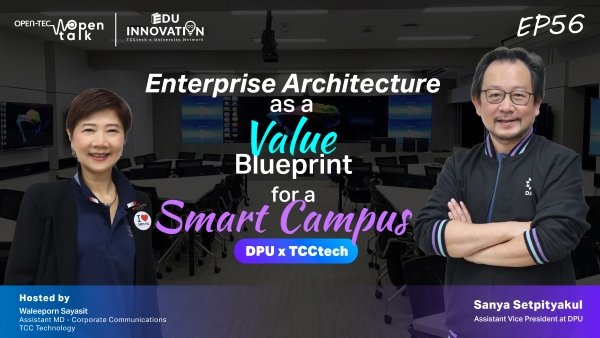
Recently, OPEN-TEC, a Tech Knowledge Sharing Platform, powered by TCC Technology Group, hosted a special panel featuring Ajarn Sanya Setpityakul, Assistant Vice President of Dhurakij Pundit University (DPU). He shared insights on the role of Enterprise Architecture in driving digital transformation within university and discussed how AI, data, and innovative technologies can be applied to enhance teaching, administration, and the overall student experience.
From Technology Perspectives to Organizational Value Design
With an educational background spanning telecommunications engineering, business administration, and organizational psychology, Ajarn Sanya has experienced leading digital transformation initiatives, data management projects, executive dashboards, command centers, and a Mobile School Platform for Thailand’s Equitable Education Fund (EEF), with the goal of expanding educational opportunities for children.
These experiences have shaped his view of Enterprise Architecture not merely as a technology management framework but as an approach that connects organizational value, digital and physical ecosystems, and the people who drive organizational success, enabling all components to work together effectively.
Enterprise Architecture: The Value Blueprint of University
Although Enterprise Architecture may sound highly technical, it can be viewed as an organization’s “Value Blueprint.” For university, the ultimate goal is to create value for students by delivering meaningful learning experiences, supporting their quality of life during their studies, and preparing them for successful careers after graduation. Achieving these outcomes requires multiple interconnected components working in harmony.
The first of these is a set of well-designed operational “processes” that align with the lifestyles and behaviors of people in the digital age, ensuring that university services are convenient, integrated, and responsive to users’ needs. Equally important are “the digital systems and platforms” that support university operations and service delivery. “Data” has also become a critical organizational asset, providing the foundation for decision-making, strategic planning, and continuous institutional improvement. At the same time, “the learning environment” itself plays a vital role by bridging the physical and digital worlds.
People: The Most Important Element
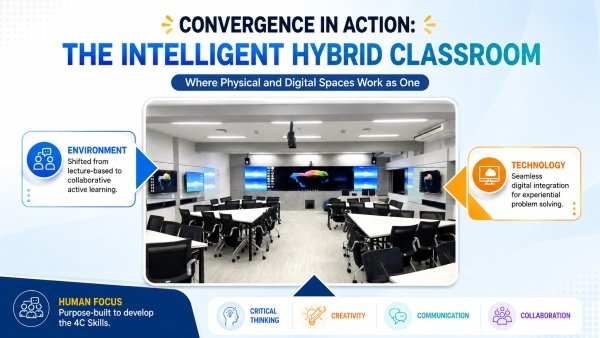
DPU’s Intelligent Hybrid Classroom has been designed to support modern learning models that prioritize student participation rather than passive listening. The classroom encourages students to develop the essential competencies of critical thinking, creativity, communication, and collaboration. To support this learning environment, robust digital infrastructure and cybersecurity systems are required to ensure that all technologies operate reliably, securely, and efficiently.
However, Ajarn Sanya emphasized that the most important element is people. No matter how sophisticated a system may be, it cannot generate meaningful outcomes unless individuals are empowered and supported to use technology effectively and create value through it. When processes, technologies, data, environments, and people are fully connected and mutually supportive, Enterprise Architecture becomes much more than a technology framework. It becomes a mechanism for reducing redundancy, increasing operational agility, and enhancing experiences for students, faculty members, and staff throughout the university.
Navigating the Future of Education Through Enterprise Architecture
Today, education sector is undergoing profound transformation driven by digital technologies, the rise of artificial intelligence, and an increasing focus on sustainability. These forces are reshaping learning methods, workplace expectations, and the characteristics society seeks in future graduates.
For DPU, one important initiative is the development of students through its “6 DPU DNA” framework, a set of skills and attributes considered essential for future success. The university has worked closely with faculty members to redesign academic transcripts so that they reflect not only academic performance but also students’ development in key competencies. This approach helps students better understand their personal growth, establish learning goals more systematically, and prepare themselves more effectively for future careers.
DPU has also adopted gamification concepts through its DPU Digital Avatar system. Students earn points by participating in learning activities and university events, and these points can be used to upgrade or unlock features of their personal digital avatars. The system was not created merely for entertainment; it also serves as a tool for encouraging positive behaviors and fostering awareness of sustainability.
One example involves the installation of smart monitoring devices to track energy consumption within campus buildings. When electricity is being used outside designated operating hours, the system sends notifications to students. Students who help turn off unnecessary electrical equipment can verify their actions through a scanning process and receive reward points within the system. This initiative demonstrates how technology can go beyond supporting learning to actively promote engagement, responsibility, and a culture of sustainability across the university.
AI and the Future of Learning
Although artificial intelligence is becoming increasingly influential in both education and the workplace, humans continue to possess strengths that technology cannot fully replicate. DPU therefore places significant emphasis on preparing students to collaborate effectively with AI.
One notable example is the DPU AI Hub. Rather than functioning solely as a tool for answering questions, the system is designed to ask questions in return, encouraging students to think critically and engage in deeper learning. This approach transforms AI from a passive information source into an active learning companion.
The system is also integrated with DPU Points and the Digital Avatar platform. Students can exchange points earned through educational activities for tokens that grant access to AI services, encouraging purposeful and productive use of AI technologies.
Looking ahead, DPU plans to develop an AI Buddy Application capable of integrating information from multiple university systems. The application will provide personalized recommendations tailored to each student’s abilities, interests, and goals, helping them navigate learning pathways that best match their individual potential.
Within university operations, AI is also being deployed to improve efficiency. It assists with network management, issue analysis, system monitoring, routine administrative tasks, and continuous process improvement. These initiatives illustrate how Enterprise Architecture creates an ecosystem in which AI enhances human capabilities rather than replacing them.
The 3E Framework: Essential Qualities of a Smart Campus Partner
Building a Smart Campus is not simply a matter of implementing new technologies. It is a long-term organizational transformation that requires collaboration with partners who understand the university’s mission and are committed to growing alongside it. The collaboration between DPU and TCC Technology moves beyond a conventional service-provider model and becomes a partnership focused on creating meaningful change and shaping the future together through three qualifications, which are “3Es.”
Empathize, which refers to the ability to deeply understand an organization’s context, culture, and mission so that technological solutions align with its genuine objectives.
Experience, which encompasses knowledge gained from working across multiple industries and allows innovative ideas from other sectors to be adapted successfully to education.
Envision, which reflects a shared vision of the future and the ability to establish long-term foundations that support sustainable growth and adaptation.
When these three qualities are present, the relationship between DPU and TCC Technology
Moving Toward a Sustainable Smart Campus Future
Lastly, Ajarn Sanya emphasized that creating a Smart Campus is not solely about technology. The true foundation lies in connecting people, purpose, and enterprise architecture so that they work together in a coherent and strategic manner. When learning outcomes, student experiences, data, digital systems, and infrastructure are thoughtfully integrated, technology evolves from a supporting tool into a powerful force for improving educational quality, creating meaningful experiences, and preparing future generations to contribute to a sustainable future.
In conclusion,
Ajarn Sanya stated “Technology alone does not make a campus smart — people, purpose, and architecture do.”
In other words, a Smart Campus is not created by technology alone. It emerges from the successful integration of people, shared goals, and thoughtful organizational design.
Source:
opentalk EP. 56
Link: https://www.youtube.com/watch?v=oSNAiPy_Zuw