
Dry Eye: A Growing Silent Threat for Screen Users — Bumrungrad Elevates Care with Advanced Diagnostic and Targeted Treatment Technologies
Dry Eye: A Growing Silent Threat for Screen Users — Bumrungrad Elevates Care with Advanced Diagnostic and Targeted Treatment Technologies

Bumrungrad International Hospital highlights the growing risk of dry eye among people in the digital age due to prolonged screen use. The condition affects an estimated 34.6% of the global population, or approximately 1 in 3 people, with prevalence reaching 52.4% in Southeast Asia. In response, Bumrungrad has enhanced its Dry Eye Clinic, adopting a Precision Diagnosis approach to identify underlying causes through advanced IDRA technology, alongside Precision Treatment that delivers targeted, personalized care using Light-Based Therapy. The approach aims to achieve better long-term treatment outcomes and reduce the risk of potential complications.
Artirat Charukitpipat, Ph.D., Chief Executive Officer of Bumrungrad International Hospital, said that dry eye is a common condition, particularly during the COVID-19 pandemic, when increased screen time contributed to its prevalence. Bumrungrad has therefore enhanced its eye care services through the Dry Eye Clinic under the Bumrungrad Eye Center, focusing on in-depth diagnosis and personalized treatment planning supported by advanced technology. Care is delivered by a team of specialists across multiple disciplines and a multidisciplinary care team to ensure comprehensive treatment in line with international standards. Bumrungrad International Hospital was also recognized by Newsweek among Asia’s Top Private Hospitals and Clinic 2026, ranking No. 1 in Asia for refractive eye surgery and No. 3 in Asia for cataract surgery, while securing the No. 1 position in Thailand in both specialties for the second consecutive year. These recognitions reflect the hospital’s commitment to advancing innovation and delivering excellence in patient care.
Maytinee Sirimaharaj, M.D., Director of the Bumrungrad Eye Center and Comprehensive Ophthalmology, Retina and Vitreous Specialist at Bumrungrad International Hospital, said that a significant number of people today experience vision problems, with more than 50% of cases remaining inadequately corrected. This is partly because many individuals are unaware of their condition or overlook warning signs, which can affect daily life and diminish quality of life. Bumrungrad Eye Center is equipped with a team of specialists and advanced technology to provide comprehensive care, ranging from routine eye examinations to complex cases and ophthalmic emergencies. The Center features 13 examination rooms and advanced technologies, including OCT-Angiography for three-dimensional imaging of internal eye structures, the ORA System to support surgical planning, and the VERION Image Guided System to enhance surgical precision and reduce potential errors.
Dry Eye Is Not Just an Elderly Condition: Prolonged Screen Use Increases the Risk
Prof. Ngamjit Kasetsuwan, M.D., Director of the Bumrungrad Dry Eye Clinic and Comprehensive Ophthalmology, Cornea and Refractive Surgery Specialist at Bumrungrad International Hospital, said that dry eye can affect people of all ages, particularly those who use screens continuously for extended periods. Screen use can reduce blinking frequency by as much as 50–60% and may also lead to incomplete blinking or inadequate eyelid closure. This can prevent the tear film’s lipid layer from spreading evenly across the surface of the eye, causing tears to evaporate more quickly.
Warning signs to watch for include eye irritation, burning, or itching; a sensation of dust or sand in the eyes; sensitivity to light or wind; redness of the whites of the eyes or eyelid margins; intermittent blurred vision; eye discomfort upon waking; or excessive tearing. If these symptoms persist, do not improve after using artificial tears, or interfere with daily life, individuals should consult an ophthalmologist for appropriate diagnosis and treatment to help prevent the condition from progressing and affecting long-term eye health.
Understanding Dry Eye: It’s Not Simply Caused by “Too Few Tears”
Nattawut Wanumkarng, M.D., Comprehensive Ophthalmology and Oculoplastic and Reconstructive Surgery Specialist at Bumrungrad International Hospital, explained that tears consist of 3 key layers: the Lipid Layer, which helps prevent tear evaporation; the Aqueous Layer, which moisturizes, nourishes, and washes away irritants; and the Mucin Layer, which helps tears spread evenly and adhere to the surface of the eye. Dry eye, therefore, is not caused solely by insufficient tear production. It may also result from excessive tear evaporation or an abnormal tear composition. Diagnosis requires a comprehensive assessment of the entire tear system, ocular surface, eyelids, and meibomian gland function.
One of the major causes of dry eye is Meibomian Gland Dysfunction (MGD), a disorder of the oil-producing glands in the eyelids that can cause tears to evaporate rapidly even when tear volume is normal. In addition to prolonged screen use, contributing factors include extended contact lens wear, eye makeup, dry weather, exposure to sunlight and wind, smoking and alcohol consumption, aging, diabetes, autoimmune diseases such as Sjögren’s disease, rheumatoid arthritis, and systemic lupus erythematosus (SLE), eyelid abnormalities, eye surgery, and prolonged use of certain medications or eye drops.
IDRA Provides In-Depth Tear Film Analysis to Identify the Underlying Cause Before Treatment
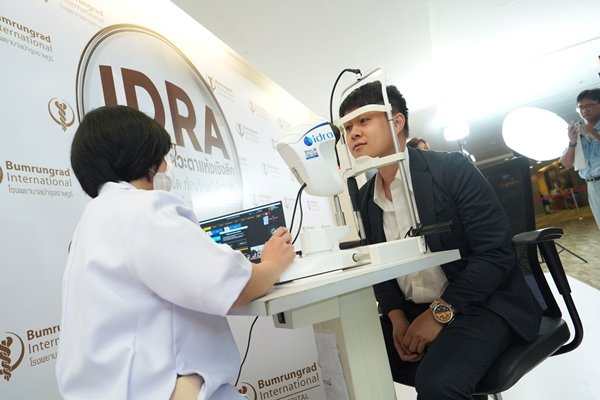
Nattawut, M.D., added that, in the past, dry eye assessments typically focused on tear volume and corneal staining, which may not have been sufficient to identify the underlying cause. Today, IDRA technology enables comprehensive analysis of the tear film across multiple dimensions, including lipid layer quality, imaging of the meibomian glands in the eyelids, tear film stability, and blinking patterns. The non-contact examination does not touch the cornea or require anesthetic eye drops, with results available immediately along with three-dimensional imaging. This enables physicians to identify the underlying cause and develop an appropriate treatment plan tailored to each patient.
Light-Based Therapy Targets the Underlying Cause
Prof. Ngamjit, M.D., said that patients with mild dry eye diseases can begin by modifying their behavior, such as taking regular breaks from screens and practicing complete blinking. If the condition is caused by MGD, treatment focuses on restoring meibomian gland function, ranging from warm compresses, eyelid massage, and cleansing (Eyelid Spa Treatment) to Light-Based Therapy. Low-Level Light Therapy (LLLT) helps stimulate the function of the meibomian glands at the cellular level, while Intense Pulsed Light (IPL) helps reduce inflammation and blockage of the meibomian glands. For some patients with severe dry eye, physicians may consider advanced treatments when indicated, such as Autologous Serum Eye Drops or Platelet-Rich Plasma (PRP) to support tissue repair and regeneration.
Prof. Ngamjit, M.D., added that dry eye is a complex condition caused by multiple factors. A Personalized Care approach, centered on each patient, focuses on identifying the underlying cause and assessing disease severity under the care of specialist physicians and a multidisciplinary team, with appropriate technologies selected to develop an individualized treatment plan. The goal is not only to relieve symptoms, but also to restore ocular surface balance, minimize the impact on vision, and help patients achieve a better quality of life.
For more information, please contact the Bumrungrad Dry Eye Clinic, Eye Center, located on 18th Floor, Building A (Clinic), Bumrungrad International Hospital, at 061-408-9622 (Hotline), or 02-066-8888 and 1378 (Contact Center).